
|
|
|
|
|
|
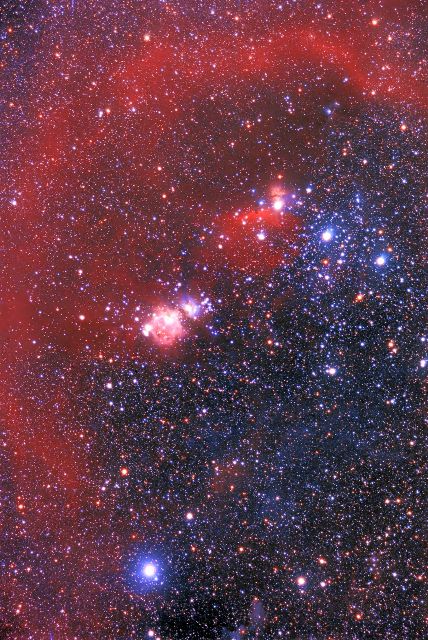
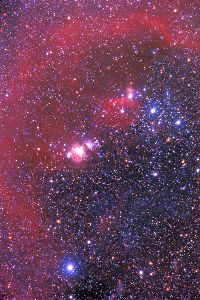
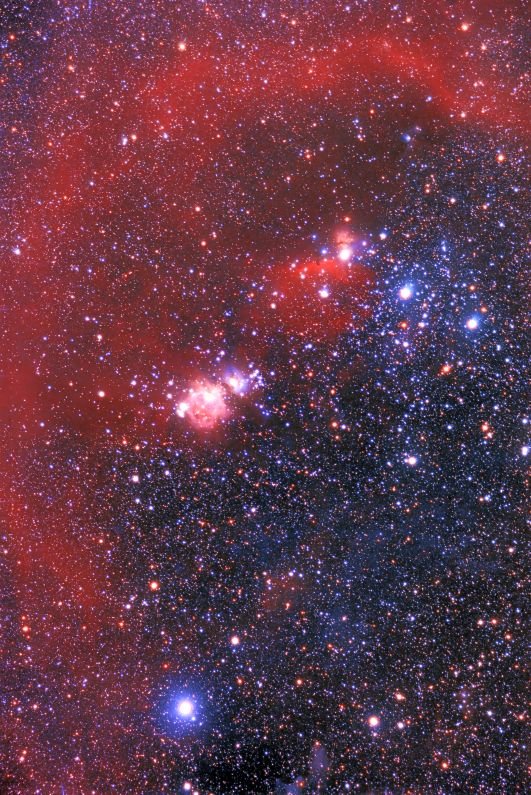
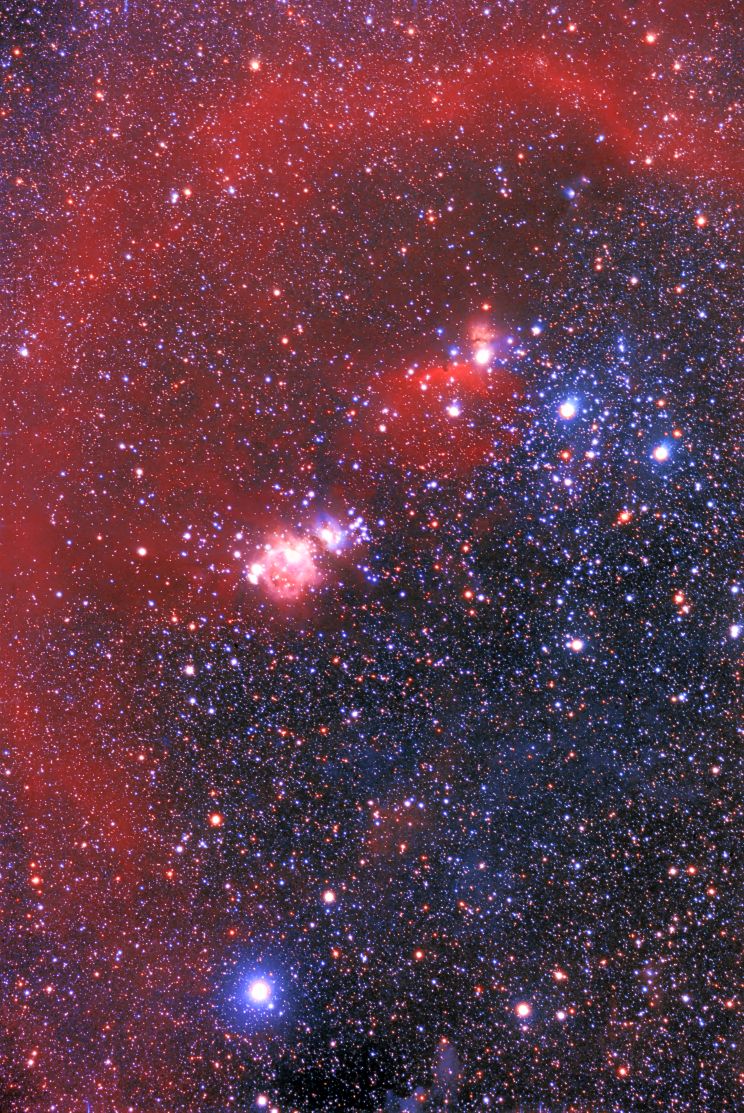
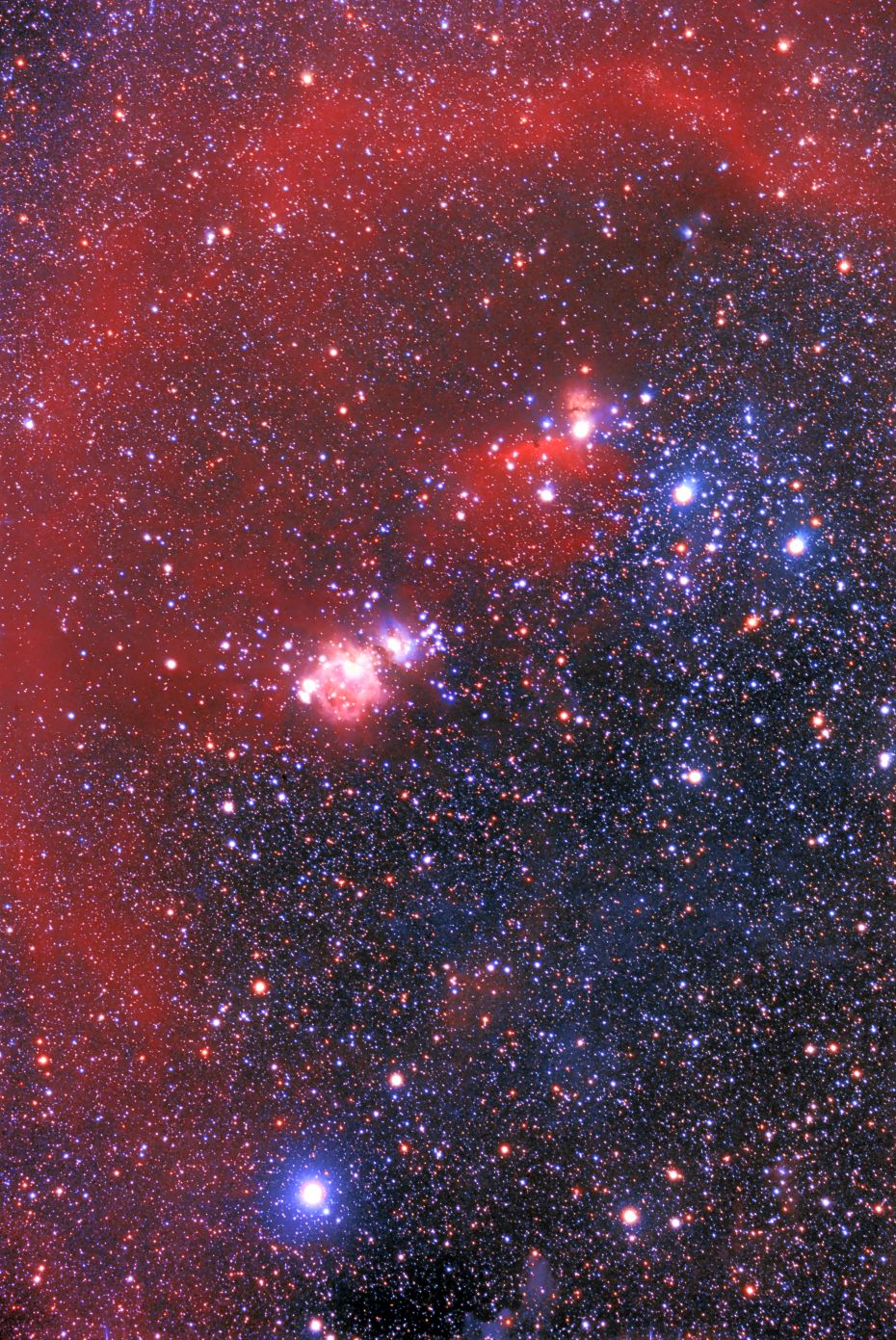
Deep Southern Orion
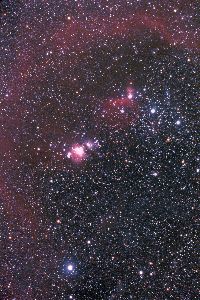
| . Data - Information - Digital Proc. - Other pics Disclaimer: The whole digital process was done using PixInsight Standard Edition (build 127). The digitalization was made using a Polaroid SprintScan 4000, 12bits RAW mode. Each one of the three images was scanned six times and then averaged with a MIN/MAX rejection method. This was done to reduce the scanner's noise, and to obtain better pixel values. Of course, every frame had to be registered to improve accuracy. Then I averaged the three images directly.
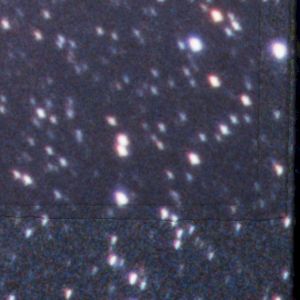
Here is a corner of the integrated image, where you can compare the average of three or two images, or only is the information of a single exposure (full resolution). After the integration, the image was cropped to include only the average of three pics.
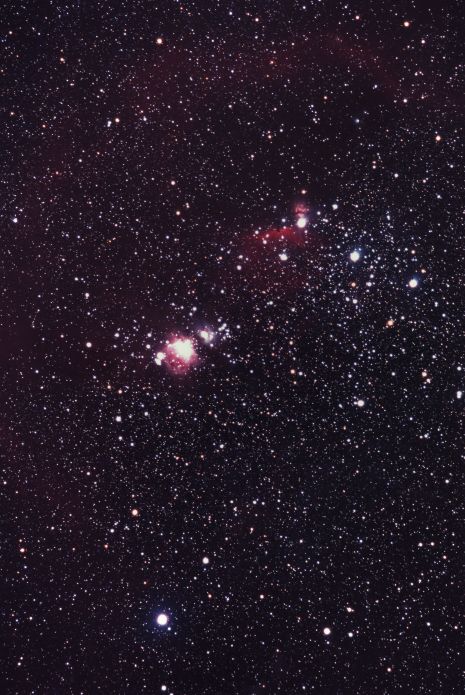
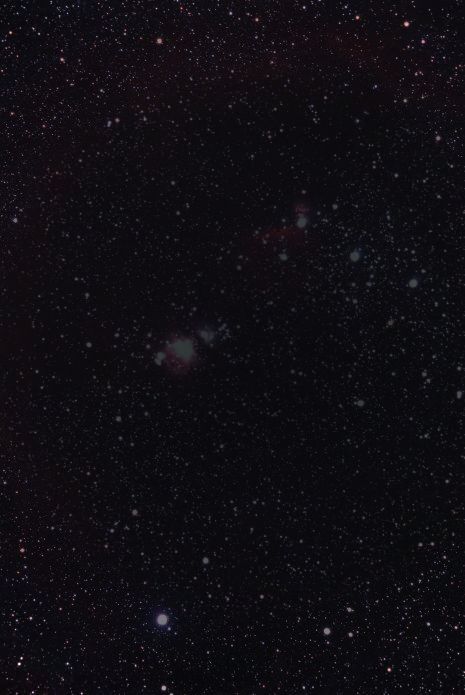
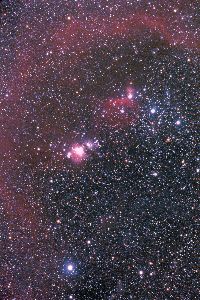
Comparison with the final result This is the "raw" image I worked with. And the first step was to align the R and B channels with respect to the G channel, to reduce the lateral chromatic aberration. Then, a model of the background was generated using DBE in order to correct the vigneting pattern..
This model, or pseudo-flat, is needed to correct the effects of univen field illumination of the film, product of the optics defects.
One way to perform this is just to substract and then rescale. This generates an uniform background (we have substracted the sky), but does not correct the brightness of the other objects. The pixel values of the stars in the centered, when compared to the borders, are not accurate. For this reason, emulating flat fielding technique that we use with CCD cameras, we must divide, becouse the uneven field illumination is a multiplicative effect.
But, division does not give any good results. This is caused for the non-linearity of the film, and we have the effect of some unknown function in the scanning procedure. Both effects yield in overcorrected objects quen we divide, so we must protect them. This can be acomplish mainly in two ways: nonlinear division, or trying to linearize the response of the film (the pixel values).
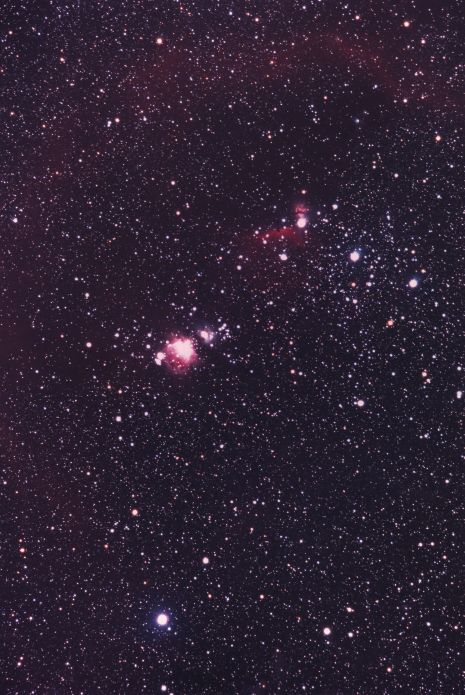
For that reason, I developed a method of linearizating the film response, becouse it is the easiest way, and then divide. This method is based upon the hipothesis that this can be acomplish with just a gamma function, and it works applying it to both the image and the flat, then divide (normalizating) and finally recovering the image's aspect with the inverse function. You can see the result above. Please note that the result is not rescaled, and then the pink look of some stars is vanished after some basic processing.
This is a roughly comparison between the linealizated division and the substraction. The images were rescaled and an order 6 PIP function was applied. You can clearly see how the division recovers the nebulosities in the borders, and hoe the objects are corrected in the center. I think that this is the better procedure in this case.
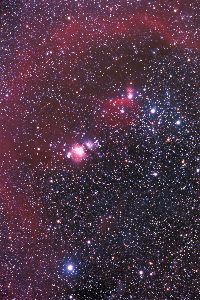
So, the next step is to rescale the information in the whole dinamical range avalaible, with a histogram transform.
The Curves adjustement helps to increase the overall brightness and to balance the colors of the background and the other objects.
PIP helps to increase the values in the shadows, without increasing that much the noise, and protecting the middletones/highlights. This is as far as I can go without reducing the noise, becouse it became very evident, and further increase the brighness will only difficult the things. NR Noise Reduction description is pending... NR
Becouse the NR techniques increased the avalaible dinamical range that can be used by the true information, we have to apply another histogram function.
Having less noise in the image, we can enchance it a lot more more, and thus we can use the PIP, Curves and Color Saturation tools again.
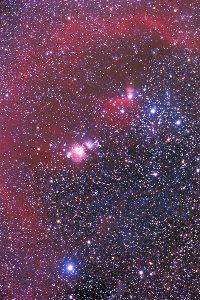
Here I decided to apply to distinct process: reduce the size of the stars, increasing theyr color saturation; and doing a middle scale feature's enchancement. For that task, I first extracted the stars from the image to a new one, using a modified high-pass filter (to avoid dark halos).There I applied sucesive iterations of minimun filters, with low amounts and size. In the meanwhile, to the image without the stars, I applied A Trous Wavelets to enchance high and middle frecuency structures. Then, after reicorporating the minimizated stars, I applied a (real)USM to enchance the low/middle scale features a bit more.
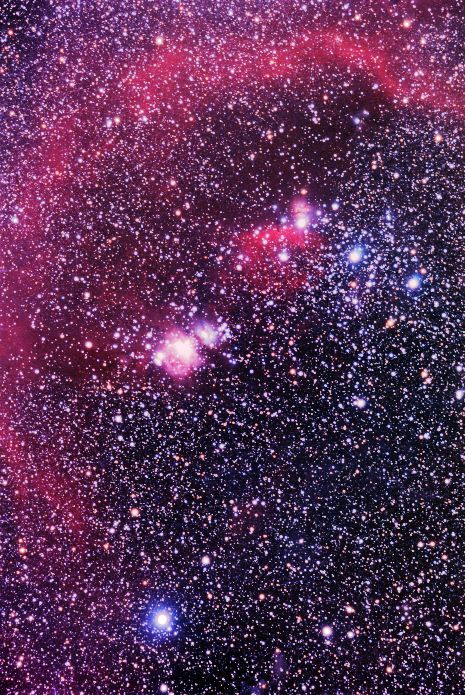
Those processes changed a bit the tone of some structures, wich was corrected with the Curves, and taking the opportunity to get to the final appereance of the image with a slighty increase of the reds in the middletones.
Before the end, I introduced information in the overexposed zones with previously taked images. This was done with a technique very similar to the well known Layer Masking (but only using masks in PixInsight). The last step was a
RRL deconvolution to recover the profile of the stars,
modificated by the "Star Shaping" procedure,
and retrieving a brighter center. . |
.
©2001-2004 Carlos Milovic Fabregat.
questions? comments? Write me at: cmilovic@puc.cl